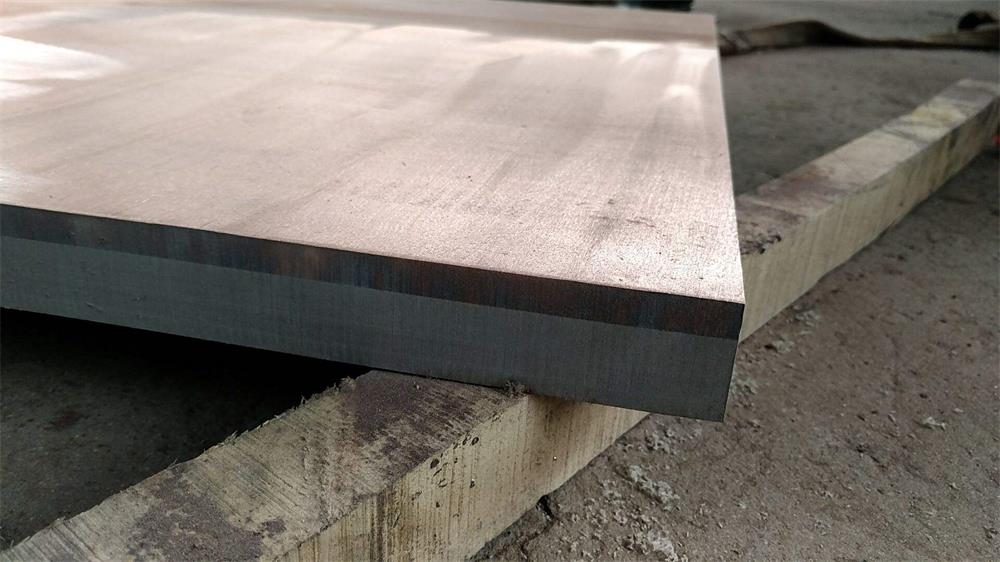

One of my clients sent me a drawing for our fabrication. The material is A36+316L, and the 316L surface material thickness should be at least one inch.
Yes, A36 carbon steel can be combined with a 316L stainless steel corrosion-resistant layer. However, the suitable manufacturing method must be confirmed according to the required 316L thickness, overall plate dimensions, bond requirements, machining allowance, and final service conditions.
Advantages of a combination of two materials
- A36 carbon steel: has good strength and toughness, is suitable for bearing structural loads, and has a low cost.
- Stainless steel 316L: Has excellent corrosion resistance and aesthetics, suitable for exposure to corrosive environments or occasions requiring appearance requirements.
What Is Stainless Steel Cladding?
Stainless steel cladding is a manufacturing technique used to bond a layer of stainless steel to a carbon steel substrate.
This method combines the structural strength and cost efficiency of carbon steel with the corrosion resistance of stainless steel.
Composite steel plates such as A36 carbon steel with a 316L stainless steel surface are widely used in chemical equipment, marine structures, and industrial machinery.
Manufacturing method
Weld overlay cladding: 316L stainless steel weld metal is deposited onto the surface of the A36 carbon steel substrate to create a corrosion-resistant layer.
Explosion bonding: The 316L stainless steel plate is metallurgically bonded to the A36 carbon steel base using controlled explosive energy.
Hot-roll bonding: The carbon steel and stainless steel layers are bonded under high temperature and rolling pressure.
Application scenarios
Chemical equipment: Containers and pipelines that require corrosion resistance and strength.
Architectural decoration: Structures that require both strength and appearance.
Shipbuilding: The hull needs to be corrosion-resistant while maintaining structural strength.
Notes
Welding process: The welding quality of the two materials must be ensured.
Thermal expansion difference: The difference in thermal expansion coefficients of the two materials must be considered to avoid stress problems.
Cost: Stainless steel is relatively expensive, and economic considerations must be made comprehensively.
The final manufacturing route should also consider the required clad thickness, overall dimensions, machining allowance, flatness, bond inspection, welding procedure, and the service environment specified by the customer.
For custom composite steel plates, machined plates, welded structures, wear plates, brackets, and other components requiring material selection, fabrication, CNC machining, dimensional inspection, and surface treatment, explore our custom precision metal parts manufacturing capabilities.
This composite steel plate can have significant advantages in specific applications.
FAQ – A36 and 316L Composite Steel Plate
Can A36 carbon steel be clad with stainless steel?
Yes, carbon steel such as ASTM A36 can be clad with stainless steel to create a composite plate combining strength and corrosion resistance.
What methods are used to bond stainless steel to carbon steel?
Common methods include explosion welding, hot rolling bonding, and weld overlay cladding.
Why combine A36 steel with 316L stainless steel?
This combination reduces cost while maintaining corrosion resistance, making it suitable for chemical equipment, marine structures, and industrial machinery.
Why use stainless steel over carbon steel?
The stainless steel layer provides corrosion resistance while the carbon steel base provides structural strength and reduces cost.
Where are stainless steel composite plates used?
They are widely used in chemical processing equipment, marine structures, pressure vessels, and industrial machinery.
Yutung Industrial can supply custom fabricated composite steel plates and welded structures based on customer drawings.