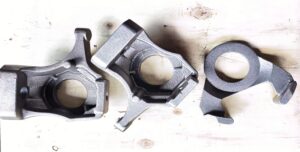
Precision Investment Casting Process: Step-by-Step Guide for Custom Metal Parts
Precision investment casting, also known as lost wax casting, is widely used to produce metal parts with complex shapes, tight tolerances, and smooth surface finishes.
At YT Industrial Parts, we support custom precision casting projects for industrial machinery, hydraulic components, automotive parts, and other engineered metal products.
In this article, we explain the precision investment casting process step by step, so customers can better understand how custom cast parts are produced.
If you are looking for a reliable supplier, you can learn more about our precision investment casting service for custom metal parts.
What Is Precision Investment Casting?
Precision investment casting is a manufacturing process in which a wax pattern is first created, then coated with refractory materials to form a ceramic shell. After the wax is removed, molten metal is poured into the cavity to produce the final casting.
This process is suitable for parts that require:
- Complex geometry
- Good dimensional accuracy
- Smooth surface finish
- Reduced machining allowance
- Consistent repeatability in batch production
Different process routes, such as water glass casting vs silica sol casting, can be selected based on cost, surface finish, and tolerance requirements.
For custom stainless steel, carbon steel, alloy steel, and heat-resistant steel components requiring wax tooling, water glass or silica sol investment casting, ceramic shell production, dimensional inspection, CNC machining, and repeat production, explore our custom investment casting parts manufacturing capabilities.
Step 1: Wax Pattern Making
The process begins with the production of wax patterns. If the part is a repeat production item, wax patterns are usually made by injecting wax into an aluminum mold.
The wax pattern must match the required shape and dimensions of the final casting. In some cases, multiple wax patterns are prepared for assembly into a tree.
Step 2: Wax Assembly
After the wax patterns are made, they are assembled onto a central wax runner to form a pattern tree.
This step helps improve production efficiency by allowing multiple parts to be cast in one shell. The design of the tree depends on the part size, weight, and pouring requirements.
Step 3: Shell Building
The assembled wax tree is dipped into a ceramic slurry and then coated with refractory sand.
This dipping and sanding process is repeated several times to build up a strong ceramic shell. The shell must be thick and stable enough to withstand dewaxing and molten metal pouring.
Step 4: Dewaxing
Once the ceramic shell has fully dried, the wax inside is removed, usually by steam autoclave or heating.
After dewaxing, a hollow ceramic mold remains. This cavity will later be filled with molten metal.
Step 5: Shell Firing and Preheating
Before pouring, the ceramic shell is fired at high temperature.
This step improves shell strength, removes residual wax, and prepares the mold for metal pouring. Proper shell firing also helps reduce casting defects.
Step 6: Molten Metal Pouring
The selected metal material is melted in a furnace and poured into the preheated ceramic shell.
Depending on customer requirements, the material may include carbon steel, stainless steel, alloy steel, or other specified casting alloys.
The pouring temperature and gating design must be carefully controlled to ensure complete filling and stable casting quality.
Step 7: Shell Removal and Cut-Off
After the metal solidifies and cools, the ceramic shell is broken away to reveal the raw castings.
The individual parts are then cut from the runner system. At this stage, the castings are separated and prepared for further finishing.
Step 8: Surface Finishing
The cast parts usually go through surface cleaning processes such as shot blasting, grinding, or polishing.
These finishing steps help remove shell residue, gates, and excess material while improving surface appearance.
Step 9: Machining if Required
Although precision investment casting can achieve good dimensional accuracy, some parts still require machining on key areas such as holes, threads, sealing surfaces, or critical mounting faces.
Machining is performed according to drawing requirements and tolerance standards.
Step 10: Inspection and Quality Control
Final inspection is carried out before shipment. Depending on the project, inspection may include:
- Dimensional inspection
- Visual inspection
- Material verification
- Mechanical property testing
- Pressure testing or functional testing
- Surface finish inspection
Quality control requirements depend on the material, application, and customer drawing specifications.
Many parts are produced using stainless steel casting due to its strength, corrosion resistance, and durability.
Advantages of Precision Investment Casting
Compared with many other casting methods, precision investment casting offers several important benefits:
- Suitable for complex part shapes
- Better surface finish
- Better dimensional control than many conventional casting processes
- Less machining required
- Good consistency for batch production
- Wide range of casting alloys available
Typical Applications
Precision investment casting is widely used for:
- Hydraulic valve components
- Industrial machinery parts
- Automotive metal parts
- Pump and valve components
- Stainless steel hardware
- Custom OEM metal parts
This process is commonly used to manufacture custom investment casting parts for various industrial applications.
Typical applications include hydraulic valve casting components used in fluid control and industrial systems.
FAQ
What is the difference between investment casting and sand casting?
Investment casting is better suited for parts with more complex shapes, finer details, and smoother surface finishes. Sand casting is usually more economical for larger parts and simpler structures.
What materials can be used in precision investment casting?
Common materials include carbon steel, stainless steel, alloy steel, and selected copper or other special alloys depending on application requirements.
Does investment casting always require machining?
Not always. Many parts can be used with minimal machining, but critical surfaces, threads, and tight-tolerance areas often still require secondary machining.
Is precision investment casting suitable for small quantities?
It can be, but the cost-effectiveness depends on part complexity, tooling requirements, and batch size. It is usually more competitive when the part geometry is complex or when stable repeat orders are expected.
Need a Reliable Precision Casting Supplier?
- Send us your drawings or samples
- Material, tolerance, quantity, and machining review
- Suitable casting process recommendation
- Export packing and international shipment support